
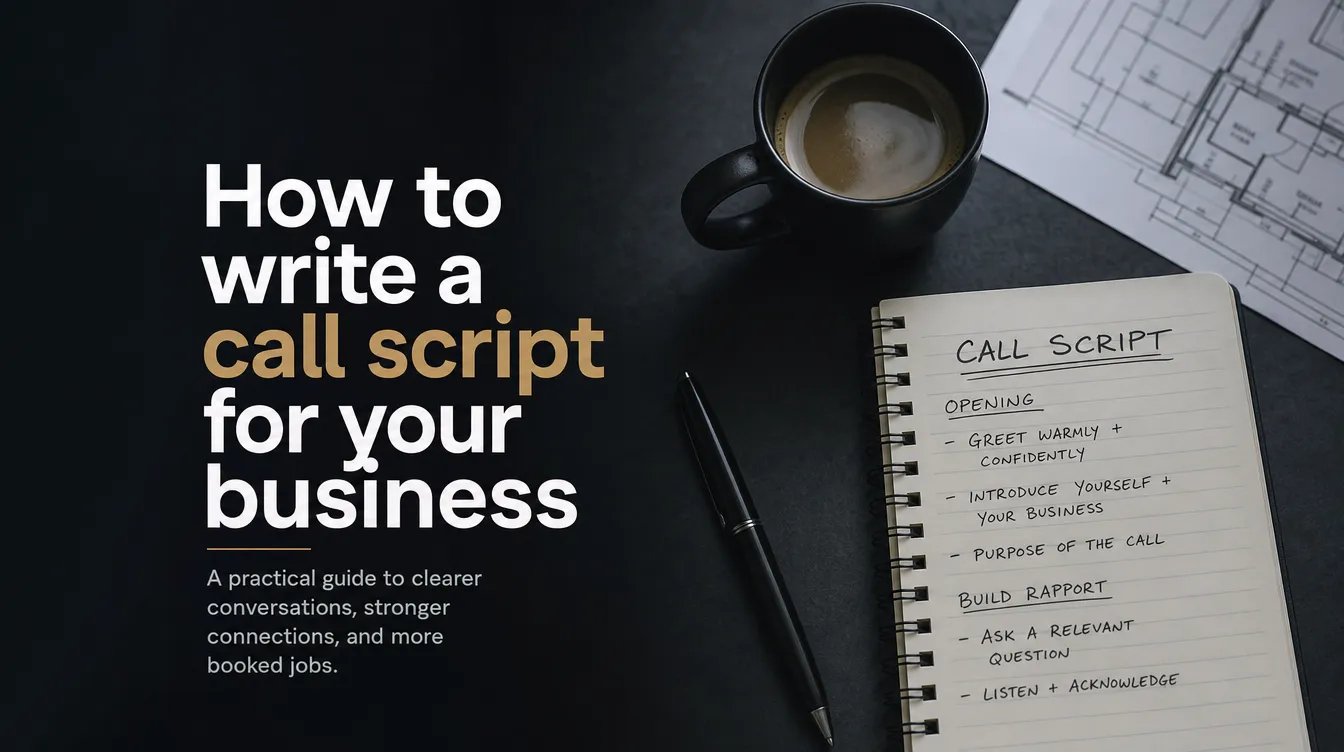
To write a call script for your business, put down on one page how the phone is answered, the question that sorts callers by what they want, the details to take from every caller, the answers you give most often, your rules on price, what counts as urgent, and what the caller is told will happen next. Plain words, in that order.
Think of it as a crib sheet rather than a speech. Its job is to make sure that anybody answering your phone, whether that is you at the end of a long day, a family member covering the school run, an apprentice or an answering service, asks what you would ask and says what you would say. This guide takes each part in turn, with example wording you can change to suit.
Why write a call script down at all?
If you answer every call yourself, the script already exists. It is in your head. You know which jobs you take, which postcodes are too far, what you charge to come out, and which callers need ringing back within the hour.
The trouble starts the moment somebody else picks up, or you pick up tired and forget to take the address. Writing it down does three things. The caller gets the same answer every time. The message that reaches you has everything needed to act on it, so you are not ringing back to ask what you should already have been told. And you find out, sometimes for the first time, what your own rules actually are.
What goes in a call script for a small business?
Seven parts, in the order a call runs:
- The greeting.
- Finding out why they rang.
- The details to take.
- The answers you give most often.
- Your rules on price.
- What counts as urgent.
- The close.
1. The greeting
Short enough to say in one breath. The caller needs to hear two things: that they have the right business, and that a person is listening. Your business name and a question does both. Leave out the slogan, the list of services and anything the caller has to sit through before they can speak. If the business name is long, agree a short version and use it every time.
2. Finding out why they rang
Straight after the greeting comes the question that sorts the call, because the reason somebody rang decides everything that follows. Start by listing the handful of reasons people phone you. For a one-van trade business they might be a new job, something urgent, a quote, a question about a job already booked, and a supplier or salesperson. For a salon, a new booking, a change or cancellation, a question about a treatment, and a price.
Each reason gets its own short path on the page. Then write the one question that points a caller down the right path. Something like "Is this about a new job, or one we are already booked in for?" does a lot of work in very few words.
3. The details to take
This part saves you the most time, because a message with a gap in it is a call you end up making twice. Write down exactly what you need, in the order you want it asked:
- Full name.
- A number to call back on, read back to the caller digit by digit.
- Address and postcode, if you go to them.
- What they need, in their own words rather than a summary.
- How soon they need it.
- The best time to ring them.
- How they heard about you, if you want to know which of your advertising is working.
Reading the number back is the step that gets skipped, and one wrong digit turns a good enquiry into nothing at all.
4. The answers you give most often
Look back over the last few weeks of calls, texts and emails, and list the questions that keep coming up. Do you work weekends? Do you come out to the villages? Are you insured? Will you take on a small job? Can I pay by card? Is there parking? Then write the answer you give, in the words you use.
Where the honest answer is "it depends", write down what it depends on. A caller who hears "it depends on whether the parts are in stock, and we can tell you the same day" has learned something. A caller who hears "I will have to ask" has not.
A list of what you do not do is just as useful. Somebody ringing about work you never take on should hear that straight away, ideally with a suggestion of where to try, rather than being promised a call back that leads nowhere.
5. Your rules on price
Settle this before anybody else answers your phone, because it is the question they will be asked most and the easiest one to get wrong. There are three sensible positions:
- A fixed price, for anything that genuinely is fixed, such as a charge to come out or a standard treatment.
- A range, with the two or three things that move it.
- No price on the phone, with the reason given, and the visit or consultation booked instead.
Write down which position applies to each type of work, and make the third one the default for anything not listed. The one thing a script should never do is leave the person answering to guess.
6. What counts as urgent
Define urgent in terms somebody can check a call against, not as a feeling. "Water coming through a ceiling." "No heating with a baby in the house." "A client who has had a reaction since their appointment." Then write exactly what happens to an urgent call: put through to you there and then, a text to you straight away, or a promise that you will ring within a set time.
Some urgent calls come before your business at all. If there is any chance of a caller reporting a smell of gas, the script should tell them to ring the gas emergency number, 0800 111 999, before anything else. If there is fire or smoke, 999. For heating work in winter, the questions worth asking first are set out in why plumbers lose winter boiler jobs to missed calls.
It helps to write the opposite list too: the calls you never want to be interrupted for. Knowing when not to disturb you is half of handling urgency well.
7. The close
Every call should end with the caller knowing what happens next, and when. "You will get a call back before six this evening to arrange a time" is something the caller can plan around. "Someone will be in touch" is not.
Only write promises you can keep. If you cannot ring back within the hour on a busy day, the script must not say you will. Finish by reading back the key details once, then thank them and let them go.
What does a call script look like on paper?
Here is the new-job path from a script for a made-up electrician who works alone. It is an illustration, not a real business, but it shows how little room each part needs:
- Greeting: "Good afternoon," then the business name, then "how can I help?"
- Sorting question: "Is that a new job, or about work we are already booked in for?"
- Urgent check: "Is any part of the house without power, or is anything sparking or smelling hot?" If there is fire or smoke, the caller is told to ring 999. If power is off, the owner gets a text now, and the caller is told to expect a call back within half an hour.
- Details: name, mobile read back, address and postcode, the job in the caller's words, how soon, best time to ring.
- Common answers: small jobs such as an extra socket are welcome. The work area is the town and the villages around it. Card payments are fine.
- Price rule: no prices over the phone. Every job is looked at and priced before any work starts.
- Close: "I will pass that on now. You will get a call back before six today to arrange a time."
Those seven lines are all the new-job path needs. The paths for quotes, booked jobs and sales calls are shorter still.
How do you test a call script before relying on it?
Ring your own business number from another phone and have somebody answer using nothing but the page. Start with an easy call, then try the awkward ones: the caller who will not give an address, the one who wants a price for something vague, the one who is upset and talking fast. Every time the person answering has to stop and ask you, the script has a gap in it.
Then read the message that comes out the other end. Could you act on it without ringing the caller to ask anything else? If not, add the missing question and run the test again.
Should you write it yourself or have it written for you?
With this guide you can write a perfectly good script yourself in an evening. The hard part is not the writing. It is the decisions behind it: which jobs you take, what you will quote, what counts as urgent. Nobody can make those for you, however the script ends up being written.
If you use an answering service, the script decides whether callers feel they have reached your business or somebody else's, so it is fair to ask any provider how theirs gets written and who writes it. At Reception Hub, writing it with you is part of setup: bespoke call scripts, a knowledge base for the answers, and escalation rules for urgent calls, all agreed before the first call is diverted. What the script can ask of us depends on the plan. Answering your common questions and taking a full message is on every plan. Booking into your diary and putting urgent calls straight through start at Growth.
Setup is from £49.50, normally £99, and plans start at £59 a month. The full breakdown is on plans and pricing, and there is more on how the answering itself works on the page about our telephone answering service. For a trade script with emergency calls in it, see the answering service for plumbers. For bookings, cancellations and clients in the chair, see the virtual receptionist for salons.
Want a hand working out what yours should say? Call Shaun on 01709 222834, or ask for a call back online. The free trial runs for seven days and does not ask for a card.