
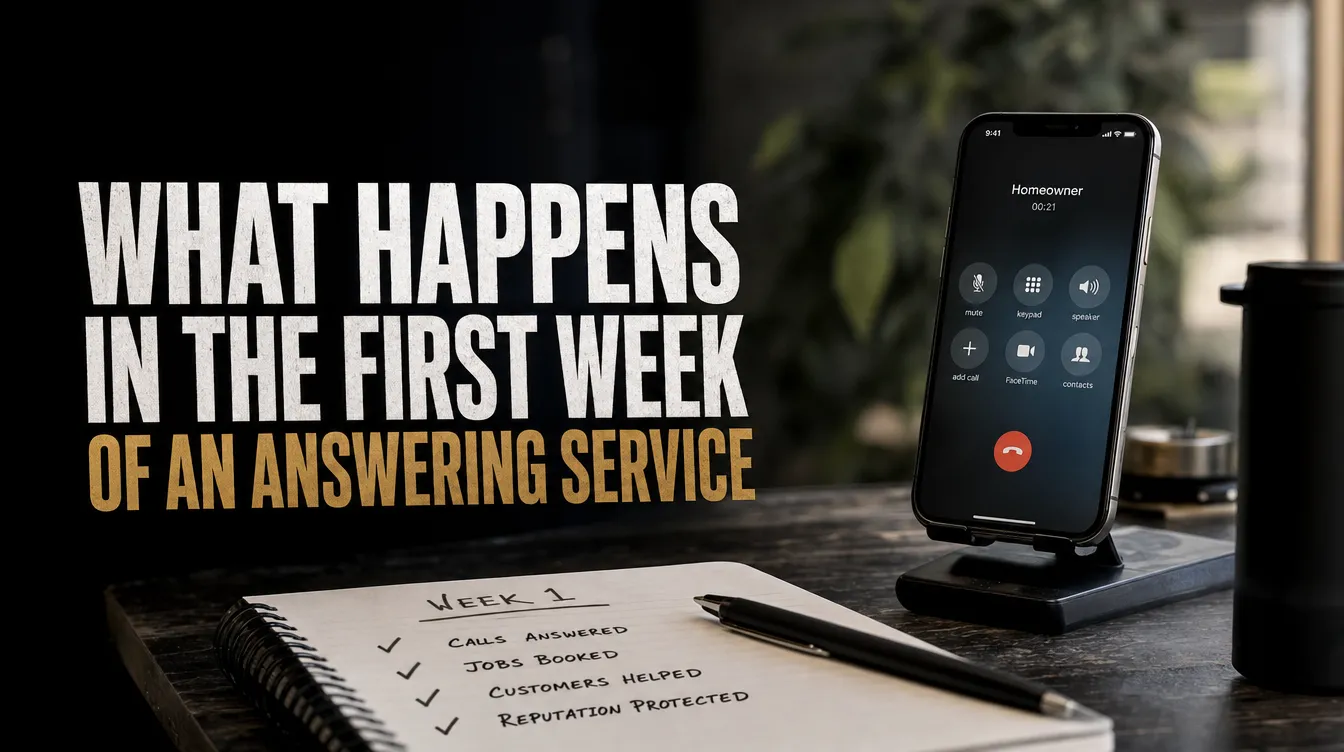
In the first week of an answering service, the calls you would have missed start being answered in your business name, and each one reaches you as a written message. It is also the week for fixing things: a question the script could not answer, a message missing a detail, an urgent call that took the wrong route. By the end of it you should know how many calls you were missing, and whether the service suits you.
That makes the first week worth treating as a test rather than a switch you flip and forget. What follows is what to expect, what to check, and what to do with what you learn.
What needs doing before the first call comes through?
It is groundwork, and at Reception Hub it is what setup covers. Setup builds seven things with you:
- Call forwarding, configured for your phone.
- A client information pack about your business.
- Call scripts written for the calls you get.
- An FAQ knowledge base with your answers in it.
- Calendar integration, for plans that book appointments.
- CRM setup.
- Escalation procedures: who gets told about an urgent call, and how.
One job stays with you, though: deciding which calls to divert. For the first week there is a strong case for diverting only the calls you do not pick up yourself, rather than everything. Your phone still rings first, you answer when you can, and the calls that come through to us are, by definition, the ones you would have missed. At the end of the week, the log is a count of exactly that, which is a number you have probably never had.
Which week should you pick?
A normal one, if you can. The point is to see what your phone does on an ordinary working week, so a week with a bank holiday in it, or one when you are away, gives you a number that tells you very little.
Make sure the week includes your busiest day. For a trade, that might be a Monday, when the weekend's problems all ring at once. For a salon, it might be a Friday or Saturday. If your work is seasonal, remember which season you are in when you read the results: a first week in a quiet month will undercount the calls you miss in a busy one.
What happens on day one?
From your customers' side, nothing changes. They ring the number they already have, and a person answers with your greeting. There is no announcement that they have reached a service, because as far as they are concerned they have reached you.
From your side, the difference is in your pocket. Each call answered for you arrives by email and by text, with the caller's details and what they wanted, and a full log of calls is kept. On Growth and Premium, some of those messages will be bookings that are already in your diary rather than requests waiting for you to act on.
Two things are worth doing on the first day:
- Read every message as it lands. Not to act on each one straight away, but to see what they look like while the calls are fresh in your mind.
- Tell anybody else who answers your phone. A partner, an apprentice, a colleague who picks up the landline. If they do not know calls are being answered elsewhere, they will wonder where the messages are coming from.
What should you check in the first few days?
Three things, and each one points at something that can be fixed.
Are the messages complete?
Take a message and try to act on it without ringing the caller first. Is the name spelled so you could find them again? Is the number right? If you go to customers, is there an address and a postcode? Does it say how soon they need you? Whatever you find yourself having to ring back and ask, add it to the questions for next time.
Did the urgent calls reach you the way you agreed?
Escalation is the part of setup that is hardest to picture in advance. If a call came in that you would have wanted to hear about at once, check that it reached you the way it should have. If one reached you that could have waited, say so. Both are a single line changed in your escalation rules.
Which questions could not be answered?
Every business gets asked things nobody thought to write down. When a message says a caller asked something that was not in your notes, send the answer back, and it goes into your knowledge base for the next caller. This is how the answers get better week by week, and the first week is when the gaps show, because everything is new.
What should you do with the messages each evening?
Give them ten minutes at the end of the day, in the same order every time:
- Anything urgent you have not already dealt with. It should have reached you already, but check.
- New work. Ring back the enquiries that could become jobs, starting with the ones that said they needed somebody soonest.
- Existing customers. Questions about work already booked or under way.
- Everything else. Sales calls and wrong numbers can be read and binned.
Then note anything you had to ask a caller that the message should already have told you, and send it over. Ten minutes spent like this in the first week is what makes the second week need less of it.
What does a good first week look like?
Not a perfect one. A first week with a handful of small corrections is a first week doing its job. The signs that it is going well:
- You stop reaching for the phone mid-job. You know that if you do not answer, somebody will.
- Your evening call-backs get shorter. The messages already hold what you need, so each return call is about the job rather than about the details.
- Callers do not mention it. When you ring somebody back and they carry on as if they spoke to you, the greeting and the manner are right.
- The corrections get smaller. Day two might bring a missing question. Day five should bring a tweak to wording.
What should the first week of an answering service tell you?
Three numbers, and they are the reason to run the week properly.
How many calls you were missing. If you diverted only the calls you did not answer, the log counts them. Treat it with a little care, because one week can be quieter or busier than usual.
How many of them were worth having. Go through the messages and sort them: work, questions from existing customers, and the ones that were never going to be anything, such as sales calls. The first group is the one that matters.
Which plan fits. Plans are priced on calls included each month. To turn a week into a month, multiply by 52 and divide by 12. Nine calls in a week works out at roughly 39 a month, which is over Light's 30 and inside Essential's 50. Twenty-two a week is roughly 95 a month, inside Growth's 100. What the calls need doing with matters as much as how many there are: if you want callers booked straight into your diary, that starts at Growth whatever your numbers say.
The homepage calculator assumes, deliberately cautiously, that one missed call in five would have become work. After a real week, you can replace that guess with your own figure.
What if it is not working?
Say so early, and start with the script and the escalation rules, because both change easily: a greeting that sounds wrong, a question asked in an order that confuses callers, urgent calls being too broad or too narrow. Those are corrections, not reasons to stop.
Sometimes it genuinely is not a fit. A business where every caller needs the owner and nobody else, and would rather wait than speak to anybody, is better off knowing that after a week than after a year. In that case, turn the divert off and your phone is exactly as it was.
What comes after the first week?
If it is working, you choose a plan and carry on. The one-off setup fee is £49.50 at the moment, half the usual £99, and plans run from £59 to £399 a month, all laid out on plans and pricing. The script is not finished on day seven either. Send the changes whenever the business changes, such as new prices, a new service, or holiday dates, and callers keep getting the right answers.
For how the answering works day to day, see the telephone answering service page. For a trade business, the answering service for electricians shows what it looks like on the tools. To start your own first week, call 01709 222834 or get in touch here. The trial is seven days, free, with no card needed.